3D6 min read
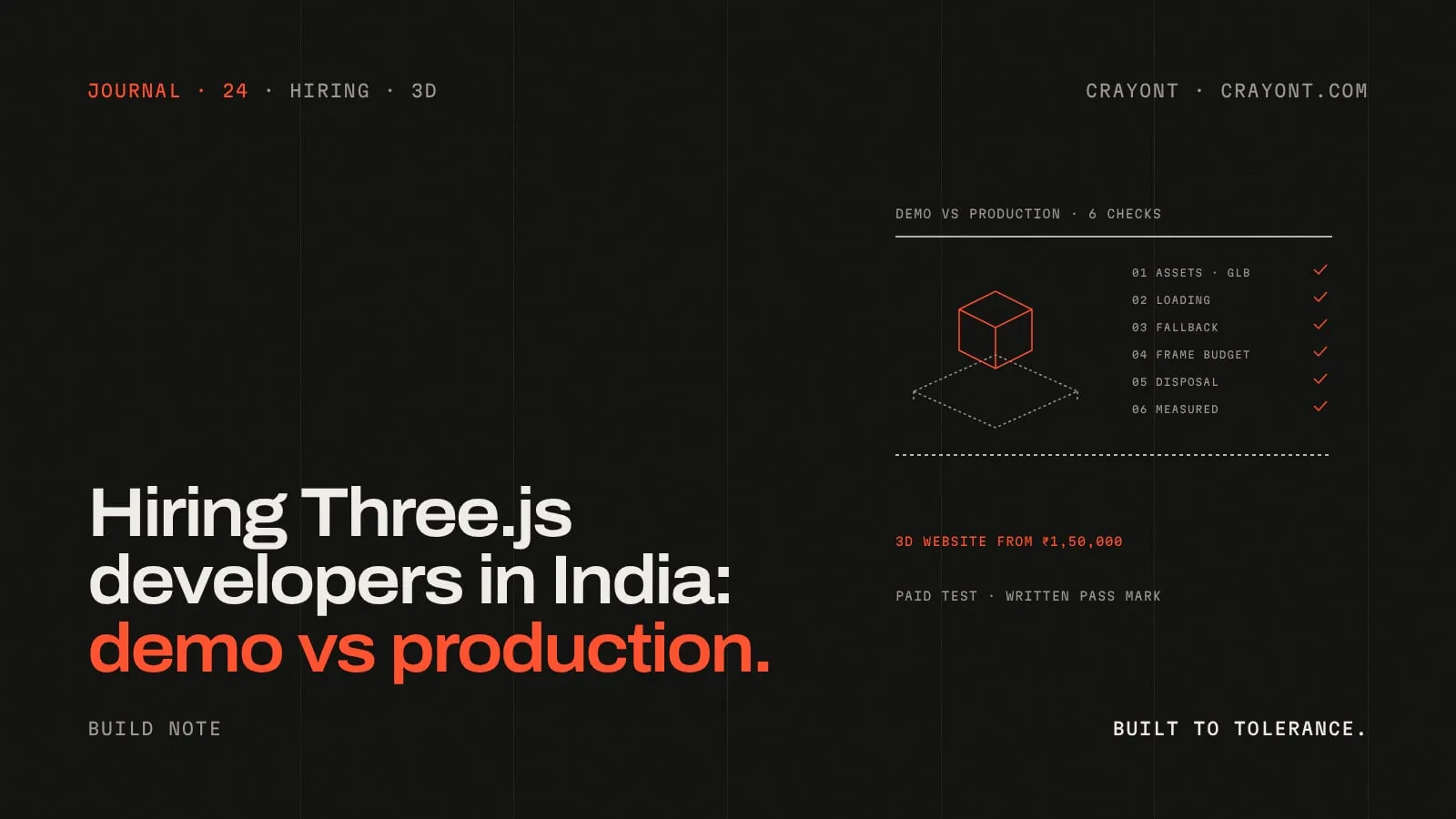
Hiring Three.js and WebGL developers in India: how to check they can ship a real 3D website
Looking to hire Three.js or WebGL developers in India? Freelancer, staffing firm or studio, the technical questions that separate demos from production work, a paid test you can copy and what it costs.

Quick summary
- A good-looking demo proves someone can make a scene. It doesn't prove they can ship a 3D website that loads fast, works on a mid-range phone and still ranks on Google.
- Ask how they prepare models (glTF, compression), when the 3D loads, what slow phones see, and how they keep the frame rate steady. Vague answers are the warning.
- A small paid test with a written pass mark tells you more than any portfolio.
- Freelancers, staffing firms and studios suit different jobs. Pick by who owns the result, not by day rate.
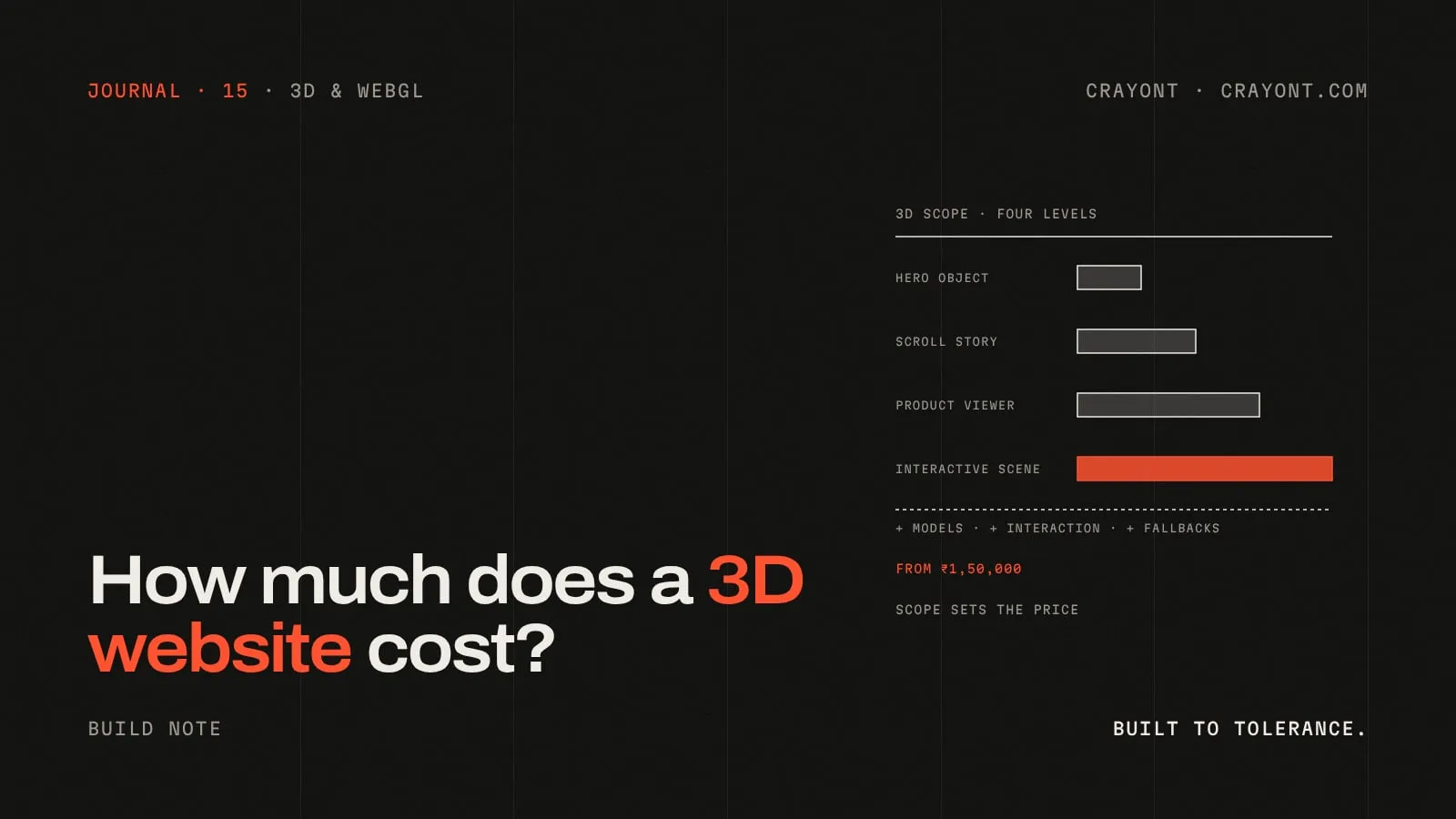
- Our 3D and WebGL websites start at ₹1,50,000, fixed against a written spec. International projects are quoted in USD, EUR or AED for the same scope.
Search for Three.js or WebGL developers in India and you’ll get staffing sites, freelance marketplaces and job boards. They’ll find you someone who has used Three.js. They won’t tell you whether that person can ship a 3D website that loads quickly, works on the phones your customers use and still brings in enquiries.
This guide is for founders, marketing teams and agencies, in India or abroad, who need 3D on the web and want to hire well. It covers the three ways to hire, the technical questions that separate demos from production work, a paid test you can copy, what it costs and the warning signs.
Demos and production are different jobs
Three.js makes it easy to build something impressive on a fast laptop. A portfolio full of glowing shaders and spinning objects proves exactly that. A production 3D website has to do much more:
What a production 3D website has to do
- Load fast on a normal connection, with a page that's usable before any 3D arrives.
- Run smoothly on a mid-range Android phone, not just a recent MacBook.
- Degrade cleanly on slow devices, data-saver mode and for visitors who prefer reduced motion.
- Stay readable to Google and AI assistants, with real text in the HTML.
- Lead somewhere: an enquiry, a quote request or a sale.
- Be maintainable, so your team can swap a model or add a product later.
When you hire, you’re hiring for that list, not for the demo.
Three ways to hire
Freelancers
Freelance platforms have plenty of developers in India with Three.js on their profile.
- Good for: one scene or one interaction added to a site you already run, when you have someone who can manage and review the work.
- Watch for: who handles design, models, performance and fallbacks. Often nobody does unless you ask.
Staffing and “hire a developer” firms
These place a developer with you by the month.
- Good for: a long product build where the 3D is ongoing work and your own lead directs it.
- Watch for: you manage the person and own the result. The firm vouches for the hire, not for your launch.
Studios
A studio scopes the job, designs it, builds it and launches it as one fixed project.
- Good for: a full 3D website, a product configurator or a launch page where design, 3D, speed and the enquiry flow have to work together.
- Watch for: studios that subcontract the 3D without telling you. Ask who writes the code.
The question that decides it: who owns the result? If you have a technical lead who will own it, a freelancer or a placed developer can work. If you want someone else to own it, hire a studio.
The questions that separate demos from production
Ask these on the first call. You don’t need to know the answers yourself. Listen for specific, confident ones, and be wary of “it depends” with nothing after it.
1. How do you prepare 3D models for the web?
A good answer mentions glTF or GLB as the format, reducing the polygon count, compressing geometry (Draco or Meshopt) and textures (KTX2 or WebP), and a size budget for the whole scene. A weak answer is “we export from Blender”.
2. When does the 3D load?
Listen for: the page loads as normal HTML with a still image first, and the 3D library and model load only once the page is usable and the scene is on screen. A weak answer is “it loads with the page”.
3. What does a slow phone see?
They should talk about checking the device and connection, and showing a designed still version to low-memory phones, data-saver mode and reduced-motion users. “It works on all devices” is not an answer.
4. How do you keep the frame rate steady?
Good answers mention capping the device pixel ratio, rendering only when something changes, pausing when the tab is hidden or the scene is off screen, keeping draw calls down and testing on a named mid-range phone.
5. How do you clean up?
3D scenes hold memory. They should mention disposing of geometry, materials and textures when the scene leaves, so the page doesn’t slow down or crash after a while.
6. How will you measure it?
Ask for speed targets in the spec (for example, page usable in under two seconds on a mid-range phone) and a measured report at launch. Our Core Web Vitals checklist lists the numbers Google uses.
7. Where does the text live?
Product names, specs and the call to action should be HTML, not text drawn inside the 3D scene. Otherwise search engines, screen readers and translation tools can’t read it.
8. Who owns the code and the models?
You should, at the end, with the source files and a short guide for updating them.
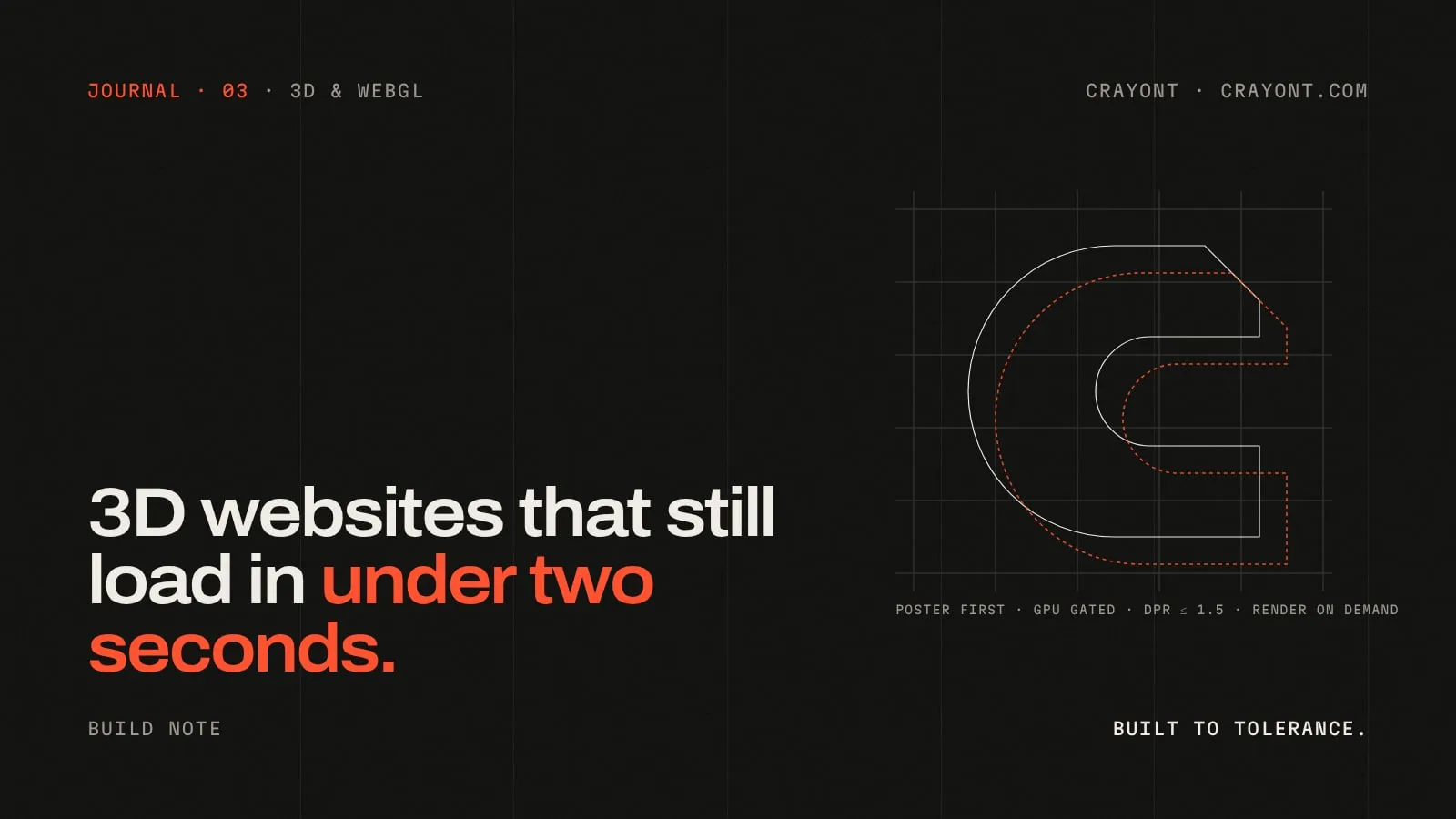
We go deeper on points 2 to 5 in 3D websites that still load in under two seconds.
A paid test you can copy
A small paid test tells you more than any portfolio. Keep it short and real, and agree the pass mark in writing before anyone starts.
Task: Put one of our products on a web page in 3D.
Input: [one model file, or photos if there's no model]
Interaction: drag to rotate, plus 3 labelled hotspots
Page: product name, 3 spec lines and a "Request a quote" button in HTML
Size budget: whole 3D scene under [e.g. 3 MB]
Speed target: page usable in under 2 s on [named mid-range phone]
Fallback: a still image for slow phones and reduced motion
Deliver: a live link, the source, and a half-page note on what you
         did to the model and how it loads
Timebox and fee: [agreed up front]Then check it yourself: open the link on a mid-range phone on mobile data, turn on reduced motion and reload, and leave the tab open for a few minutes and switch back. The note matters too. Someone who can explain clearly what they did can usually explain clearly when something goes wrong.
What it costs
Staffing firms and freelance platforms price by the hour or month, so the total depends on how long the work takes and how much managing you do. A studio prices the result.
Our starting prices:
| What you need | Starting price |
|---|---|
| 3D and WebGL website | ₹1,50,000 |
| Website without 3D (up to 8 pages, CMS, SEO set-up) | ₹60,000 |
| Web app or portal | ₹2,50,000 |
| Speed and SEO audit with a fix list | ₹15,000 |
International projects are quoted in USD, EUR or AED for the same scope. What moves a 3D price: the state of your models, how many products or scenes, which interactions, and where the enquiries have to go. The full breakdown is in how much a 3D website costs.
Warning signs
- The portfolio is all demos. No live client sites, or none you can open on your phone.
- No still-image fallback. On a slow phone the page is blank until the 3D loads.
- Text inside the canvas. Headings and prices drawn in the 3D scene instead of HTML.
- No size or speed numbers. “It’ll be optimised” without a budget in writing.
- Nobody owns the models. The developer expects you to supply finished, web-ready models without saying so.
- You can’t talk to the person writing the code.
The question that decides it: who owns the result?
If you’re an agency
Many agencies in the UK, Europe and the Gulf design 3D work in-house and need a developer to build it. The questions above apply, plus two more: will they work from your design files without changing them, and will they stay invisible to your client? We do this as white-label work. Our notes for overseas buyers are in hiring a web design agency in India from the UK or the Gulf.
How we work
We’re Crayont, a two-founder design-engineering studio in Vellore, India. I (Riyaz) design and build the front end and the 3D in Three.js and GLSL. Salman builds the back end, enquiry forms and integrations. When a project needs new 3D models, a 3D artist joins and you’ll know who they are from day one.
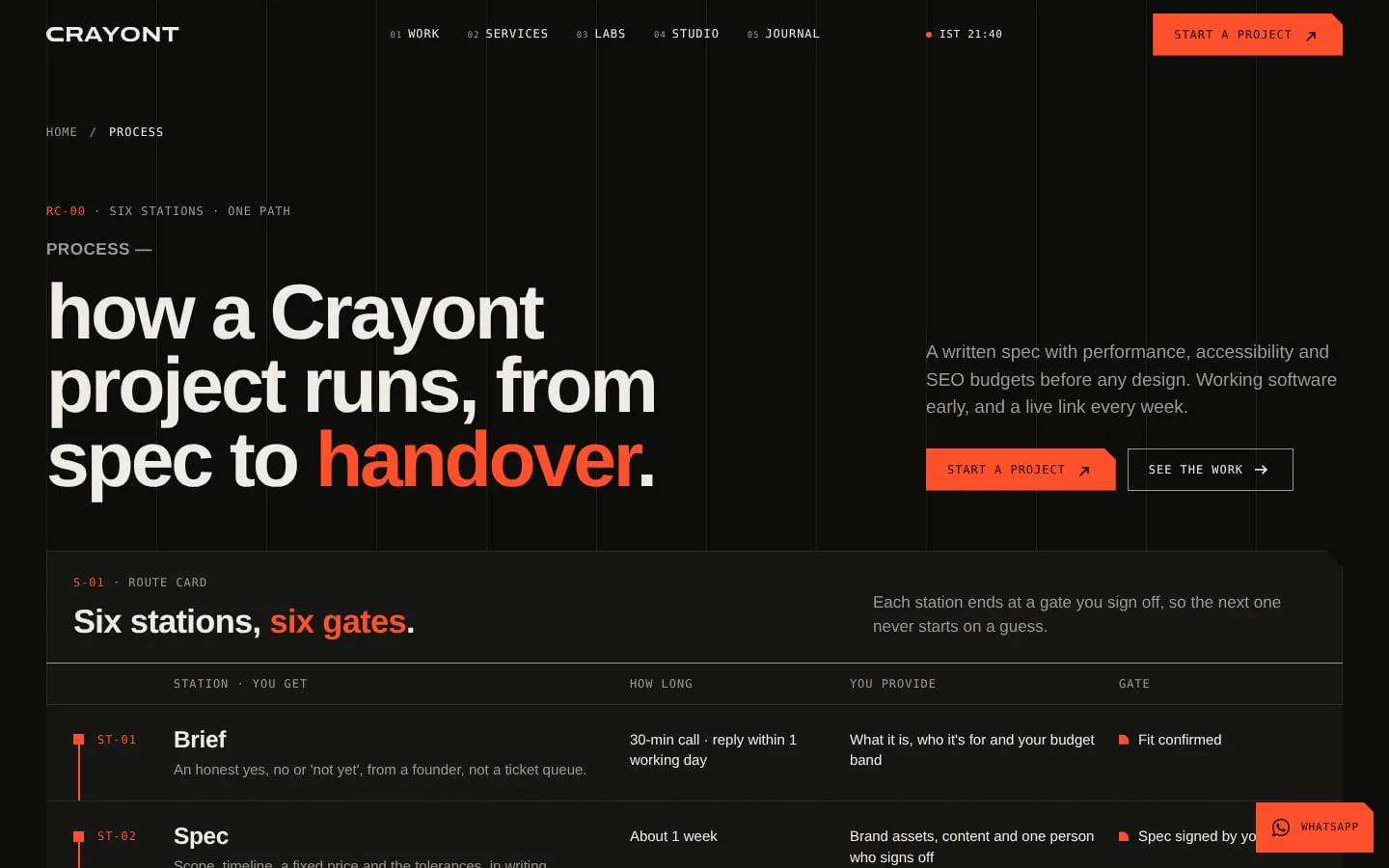
Every project starts with a written spec that includes the size budget, the speed target on a named phone and the fallback. You get a preview link every week and a short written update every Friday. The steps are on our process page.
See the full 3D and WebGL website service, what we’ve built on the work page, or send us a brief, even a rough one. You’ll get an honest yes, no or “start with one scene” within a working day.
Questions people ask
- How much does it cost to hire a Three.js developer in India?
- It depends on the model. Staffing firms and freelance platforms charge by the hour or month. A studio quotes a fixed price for a defined result: our 3D and WebGL websites start at ₹1,50,000 against a written spec, and international projects are quoted in USD, EUR or AED for the same scope.
- Should I hire a freelancer or a studio for a 3D website?
- A freelancer can work well for a single scene added to a site you already run, if you can manage the build and test it yourself. A studio suits a full 3D website where someone has to own design, build, speed, fallbacks and launch together.
- What should a Three.js test task include?
- One real model from your product, a defined interaction, a size budget, a speed target on a named phone, a still-image fallback and a short write-up. Pay for it, and agree the pass mark before work starts.
- Will a 3D website hurt our Google rankings?
- Not if it's built properly. Text, headings and links should be normal HTML that loads first, with the 3D loading afterwards. Search engines and AI assistants then read the page like any other.
- Do you work with clients outside India?
- Yes. We work remotely with a written spec, a preview link every week and a written update every Friday, and we quote international projects in USD, EUR or AED.
Keep reading
All notes →- 3D product configurators for Bengaluru brands: when they're worth it, how they're built, what they costLooking for a 3D or WebGL website developer in Bengaluru? When a product configurator is worth building, how a fast Three.js configurator works, what it costs and a brief you can copy.
- How much does a 3D website cost? What actually drives the price of a Three.js siteWhat a 3D or WebGL website costs, the six things that move the price, and how to scope one so you don't pay for 3D nobody sees. With our starting price and process.
- 3D and WebGL websites that still load in under two secondsHow we build 3D and WebGL websites that stay fast on a mid-range phone: poster first, GPU gating, on-demand rendering and a designed reduced-motion state.