AI7 min read
AI tool ideas for small businesses in 2027: five small tools you can build, and what they cost to run
Five small AI tools to build for shops, clinics and tuition centres in 2027: voice notes to bills, enquiry replies in Tamil and English, price-list search, enquiry sorting and read-aloud updates. With the model for each and the running cost worked out from Cloudflare's published prices.

Quick summary
- The AI tools small businesses will pay for in 2027 do one dull job: turn a voice note into a bill, draft a reply in the customer's language, find the right item in a price list.
- Most of these run on Cloudflare Workers AI. It gives 10,000 free Neurons a day, then charges $0.011 per 1,000 Neurons.
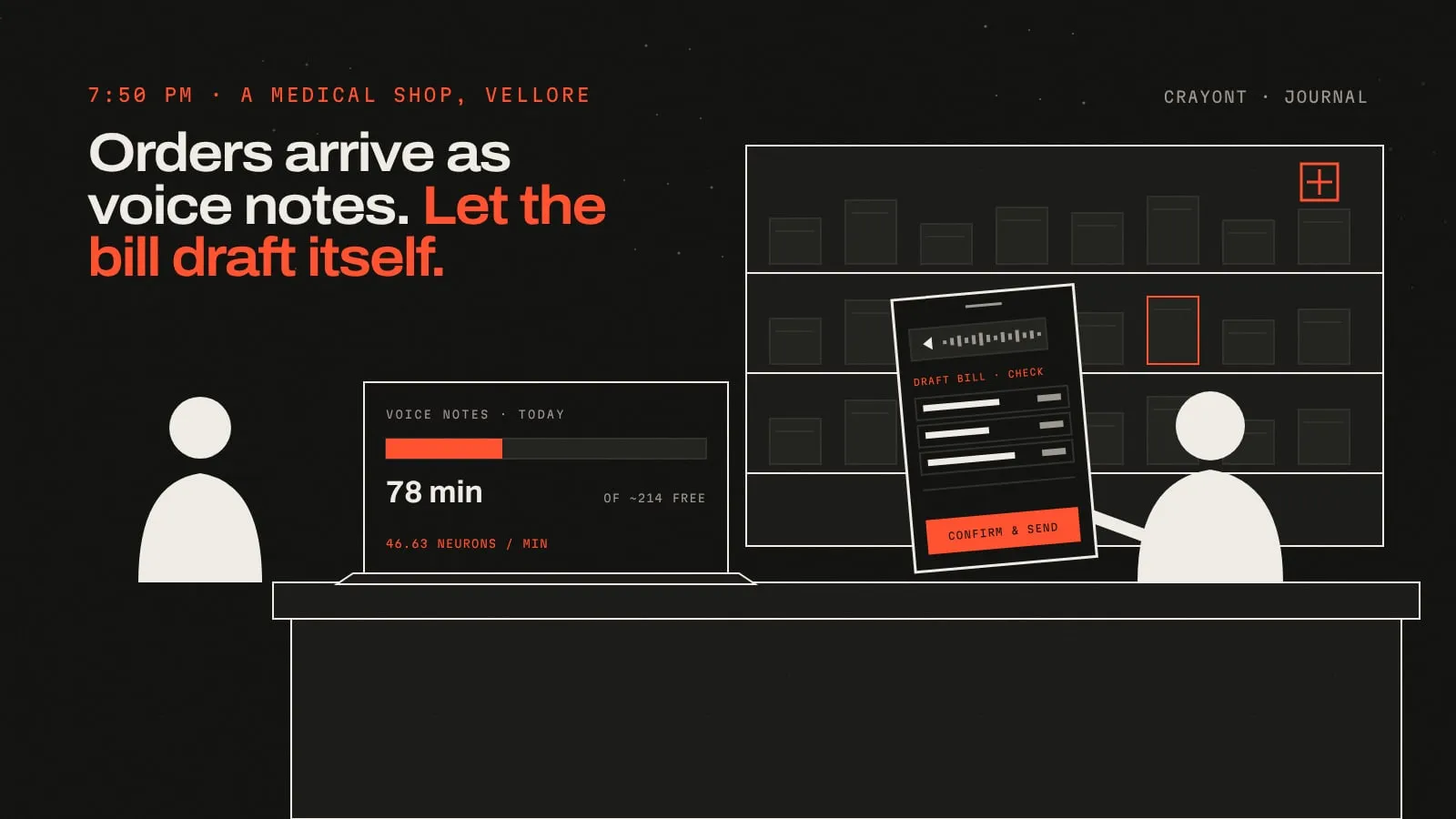
- Speech to text with Whisper large v3 turbo costs 46.63 Neurons per audio minute, so the free allowance covers about 214 minutes of voice notes a day.
- Build for one trade in one town first. A generic 'AI assistant for small businesses' has no buyer you can walk up to.
- Skip AI where a mistake costs money or health: prices, doses, legal advice. Keep a person in the loop there.
The AI tools a small business will actually pay for in 2027 are small and boring: a voice note that turns into a bill, a reply drafted in the customer’s own language, a search box that finds the right item in a messy price list. Each one removes a chore someone does fifty times a day.
Below are five you can build, with the model I’d use for each and what it costs to run, worked out from Cloudflare’s published Workers AI prices. Most of them run free at a single shop’s volume.
When I searched for this topic, almost every page was a list of AI tools to buy: chat assistants, writing tools, meeting note-takers. Useful if you run an office in English. Not much use to a medical shop in Vellore that takes orders as Tamil voice notes. This post is for the person who wants to build for that shop.
The running cost, before the ideas
Cost decides which ideas make sense, so here are the numbers first. All of these come from Cloudflare’s Workers AI pricing page, which I read while writing this.
A “Neuron” is Cloudflare’s unit for AI work. Each model uses a different number of them per request, and the free allowance resets at 00:00 UTC, which is 5:30 AM in India. Going past 10,000 a day needs the Workers Paid plan, which starts at $5 a month and still includes the free 10,000.
One more thing changed this year. Since 28 July 2026, some of the larger text models (Kimi K2.6, Kimi K2.7 Code and GLM 5.2) need the Paid plan. Smaller ones such as GLM 4.7 Flash and Gemma 4 still run on the Free plan, and for the short jobs below, small is enough.
1. Voice notes into bills and orders
The chore. Customers send orders as voice notes: “two packets of Aavin milk, one kilo sugar, the usual soap.” Someone listens, types it, and makes the bill. Medical shops, grocery shops and hardware stores all do this by hand.
The tool. Whisper turns the voice note into text. A small text model matches the words to the shop’s own item list and returns a draft bill. The owner checks it, fixes anything wrong, and sends it back.
The model. whisper-large-v3-turbo for speech, at 46.63 Neurons a minute. A small text model with JSON mode, so the output is a clean list of items and quantities rather than a paragraph.
What it costs. Here’s the sum, worked out from the published rates:
- 10,000 free Neurons ÷ 46.63 per minute ≈ 214 minutes of voice notes a day, free. Most single shops won’t get near that.
- A busy shop sending 1,000 minutes a day uses 46,630 Neurons. Take off the free 10,000 and you pay for 36,630, which is about $0.40 a day, or roughly $12 a month plus the $5 plan.
This is the idea I’d pick first. We already build Fatura, a billing app for grocery shops that bill in Tamil and English, and the slowest part of a shop’s day is still turning what a customer said into what’s on the bill.
2. Enquiry replies in Tamil and English
The chore. A clinic, counsellor or tuition centre gets the same ten questions every day: timings, fees, location, whether a seat is free. Half arrive in Tamil, half in English, some in both in one sentence. The person answering is also doing their real job.
The tool. The business writes its answers once, in its own words. When an enquiry arrives from the website form, the tool finds the closest answer and drafts a reply in the language the person wrote in. A staff member reads it and sends it.
The model. A small text model for the draft, and m2m100-1.2b, which Cloudflare lists as many-to-many translation, if the answers are stored in one language only.
Keep the draft step. A counsellor shouldn’t have a machine answering a worried parent on its own, and a tuition centre shouldn’t quote a fee that changed last week. The tool writes the first draft and the person still sends it.
3. Search a price list by meaning, not spelling
The chore. A hardware shop has 4,000 items in a spreadsheet. A customer asks for “the white pipe glue” and the staff member searches “glue”, “solvent” and “PVC” before finding it. The shop’s website search is worse, because it only matches exact words.
The tool. Turn every item’s name and description into an embedding, store them, and search by meaning. “White pipe glue” finds the PVC solvent cement even though none of those words match exactly.
The model. bge-m3, which handles more than 100 languages, so a Tamil query can find an English item name. Add bge-reranker-base to put the best match on top. Embedding a price list is a one-off job, and each search after that is tiny.
Who pays. Shops with big catalogues and small staff: hardware, electricals, auto parts, wholesale stationery. It also works on a website’s search box, which is where we’d start, because a better search on a site you already have is easy to sell.
4. Sort messy enquiries into a clean sheet
The chore. A tuition centre gets 40 WhatsApp and form enquiries a week in March. Each says something like “my son is in 9th, needs maths and science, we’re near Katpadi, evening batch.” Someone copies the details into a register, or they don’t, and the lead is lost.
The tool. Every enquiry goes through a text model with JSON mode switched on, which returns the same fields every time: class, subjects, area, preferred time, phone number. The row lands in a sheet or a small dashboard, and the centre calls back in order.
Why it works. Structured output is the most reliable thing small models do. You’re not asking it to be clever, only to fill in five boxes. And when it gets one wrong, the original message is right next to the row.
The rest of the tuition centre's siteWhat a tuition centre website in Tamil Nadu needs in 20275. Short spoken updates for customers who’d rather listen
The chore. Some customers don’t read long messages, especially older ones. A clinic’s “your report is ready, collect after 4 PM, bring the receipt” gets a call anyway.
The tool. Turn the short text update into a voice clip and send both. The customer can read it or play it.
The model. Workers AI lists melotts for multilingual speech and Deepgram’s Aura for English. Check the voice in your language before you build anything. If it sounds wrong to a local listener, it will annoy more people than it helps.
This is the idea I’m least sure about, so I’d test it as a manual service first. Record the clips yourself for a month and see whether people actually play them.
How to choose between them
Build this
One chore, one trade, one town
Voice-note bills for medical shops in Vellore. You can visit ten of them this week.
Not this
An AI assistant for all small businesses
No buyer you can name, and a hundred funded tools already say the same thing.
Then score the idea before you write code:
Before you build any of these
- Volume: the chore happens at least 20 times a day in one business.
- Language: you've tested the model on 50 real messages in the buyer's language, accents included.
- Person in the loop: a human confirms anything that costs money or goes to a customer.
- Cost sum: you've worked out the Neurons per job and the monthly bill at ten times today's volume.
- Manual first: you've done the job by hand for a week and the owner still wants it.
When not to build an AI tool
Some jobs look like AI jobs and aren’t.
- Prices and stock. If the answer is “₹240, three in stock”, read it from the database. Don’t let a model write it.
- Anything medical or legal. A drafted “your report is ready” is fine. A drafted “this dose is safe” is not.
- Fake product photos. Workers AI lists text-to-image models such as Leonardo’s Lucid Origin. Use them for a banner background if you like, never as the picture of what the customer is buying.
- When a form would do. If customers would happily tick three boxes, give them three boxes. Less to go wrong, and nothing to pay per request.
- When the volume is tiny. Five enquiries a week don’t need a model. They need someone to reply the same day.
What it costs to build
Running costs are small. Building is where the money goes, so here’s our price list, which I know is true:
- A one-page site to test the idea (problem, price, a WhatsApp button): from ₹12,999 with our starter package, and you see a free sample homepage before you pay.
- The tool itself (logins, a dashboard, the model calls, a sheet or WhatsApp connection): our web app work starts at ₹2,50,000.
Spend the small amount first. Ten paying shops on the manual version tell you more than any demo. If you’re in Vellore or nearby, our web development page for Vellore has the local details, and the work page shows what we’ve built for shops, clinics and schools so far.
At Crayont, the front end and the product are mine. My brother Salman, our co-founder, builds the back end, which on these tools is most of the work: the Worker that calls the model, the database, the bit that retries when a voice note fails to upload. If one of these ideas is yours, send it over.
Questions people ask
- What are good AI tool ideas for small businesses in 2027?
- Small tools that remove one chore: a voice note that becomes a bill or an order, a draft reply to an enquiry in Tamil or English, a search box that finds items in a shop's own price list by meaning, a sorter that turns messy enquiries into rows in a sheet, and short spoken updates for customers who prefer listening to reading.
- How much does it cost to run an AI tool for a small business?
- Often nothing at first. Cloudflare Workers AI includes 10,000 Neurons a day free, on both the Free and Paid plans. Above that it costs $0.011 per 1,000 Neurons, and you need the Workers Paid plan, which starts at $5 a month. A shop sending 1,000 minutes of voice notes a day would cost about $12 a month in AI use on top of that, worked out from the published rates.
- Which AI models work for Tamil and other Indian languages?
- Workers AI lists multilingual models: Whisper for speech recognition, m2m100 for translation between many languages, bge-m3 for search across more than 100 languages, and MeloTTS for multilingual speech. Test every one on real messages in your language with a native speaker before you sell it. Quality varies by language and by accent.
- Should a small business build its own AI tool or buy one?
- Buy one if a tool already does the job in your language and fits how you work. Build when the job is specific to your trade or town, like bills in Tamil for a grocery shop, and the off-the-shelf tools are made for English-speaking offices.
- Can Crayont build an AI tool for my business?
- Yes. We're a two-founder design-engineering studio in Vellore. A small web app with logins and integrations starts at ₹2,50,000; a one-page site to test the idea first starts at ₹12,999. Tell us the chore you want gone and we'll reply with what the first version should do.
Keep reading
All notes →- Side projects developers can launch in 2027: small tools for people you can actually reachSix side project ideas for developers in 2027, built for buyers you can walk up to: shops, tuition centres, clinics, print shops and trusts. With the free-tier maths on Cloudflare Workers and D1, and what we learned shipping Redlyn and Fatura.
- Startup ideas to work on in 2027: six openings created by real deadlines and platform changesSix startup ideas for 2027, each tied to a rule or platform change you can check yourself: who pays, why now, what the first version needs, what it costs to build in India, and how to test it in two weeks.
- Website maintenance cost in India in 2027: what you're actually paying for each monthWhat website maintenance costs in India in 2027, split into the running costs you pay anyway and the work someone does each month. With a copyable monthly checklist, what we found when we checked our own site's code today, and when you don't need a maintenance plan at all.